Monoclonal antibodies (mAbs) represent a core category of macromolecular therapeutic drugs and occupy a significant position in the global pharmaceutical market. To date, more than 100 antibody drugs have been approved for marketing in China, widely applied in oncology, autoimmune diseases, hematological disorders and other fields.
In the industrial manufacturing of mAb drugs, downstream purification typically accounts for over 60% of the total process cost. Chromatography serves as the core unit operation for isolating target antibodies. The selection of chromatographic media and process‑combination strategies directly impact final‑product quality, process yield and production capacity. Based on mainstream mAb purification workflows, this paper elaborates on the technical principles, application positioning and key media‑selection points for affinity chromatography, ion‑exchange chromatography and hydrophobic‑interaction chromatography. Combined with Hedera‑series chromatographic media from Hand‑Tech, it provides references for downstream‑process development and industrial‑scale scaling‑up of monoclonal antibodies.
1. Overview of Monoclonal Antibodies and Purification Strategies
Antibodies are the most important effector molecules of the immune system, with multiple biological functions including antigen binding, toxin neutralization and cellular‑cytotoxicity mediation. Monoclonal antibodies are generated by proliferation from a single cell clone and can specifically recognize a single antigen epitope. Characterized by high purity and strong specificity, they are widely used in targeted therapy and diagnostic applications. From murine antibodies, human‑mouse chimeric antibodies to humanized and fully‑human antibodies, immunogenicity has been progressively reduced, continuously improving drug safety and therapeutic efficacy.
In industrial production, most mAbs are expressed and secreted extracellularly by CHO cells. After solid‑liquid separation to obtain clarified feedstock, materials enter downstream purification workflows. The mainstream industrial purification strategy adopts a three‑step chromatographic approach: the first step is affinity capture to remove most impurities; the second step applies cation‑exchange or anion‑exchange chromatography for intermediate purification; the third step uses anion‑exchange or cation‑exchange chromatography for final polishing. For antibodies with well‑optimized molecular design and high expression levels, a two‑step workflow (affinity capture plus anion‑exchange polishing) can achieve efficient preparation.
2. Overview of Downstream Purification Workflow for Monoclonal Antibodies
The downstream manufacturing workflow for mAbs includes solid‑liquid separation, chromatographic purification, viral inactivation, ultrafiltration/diafiltration (UF/DF) for concentration and buffer exchange, virus‑retentive filtration, sterile filtration and other unit operations. Three‑step chromatography constitutes the core link to guarantee product quality.
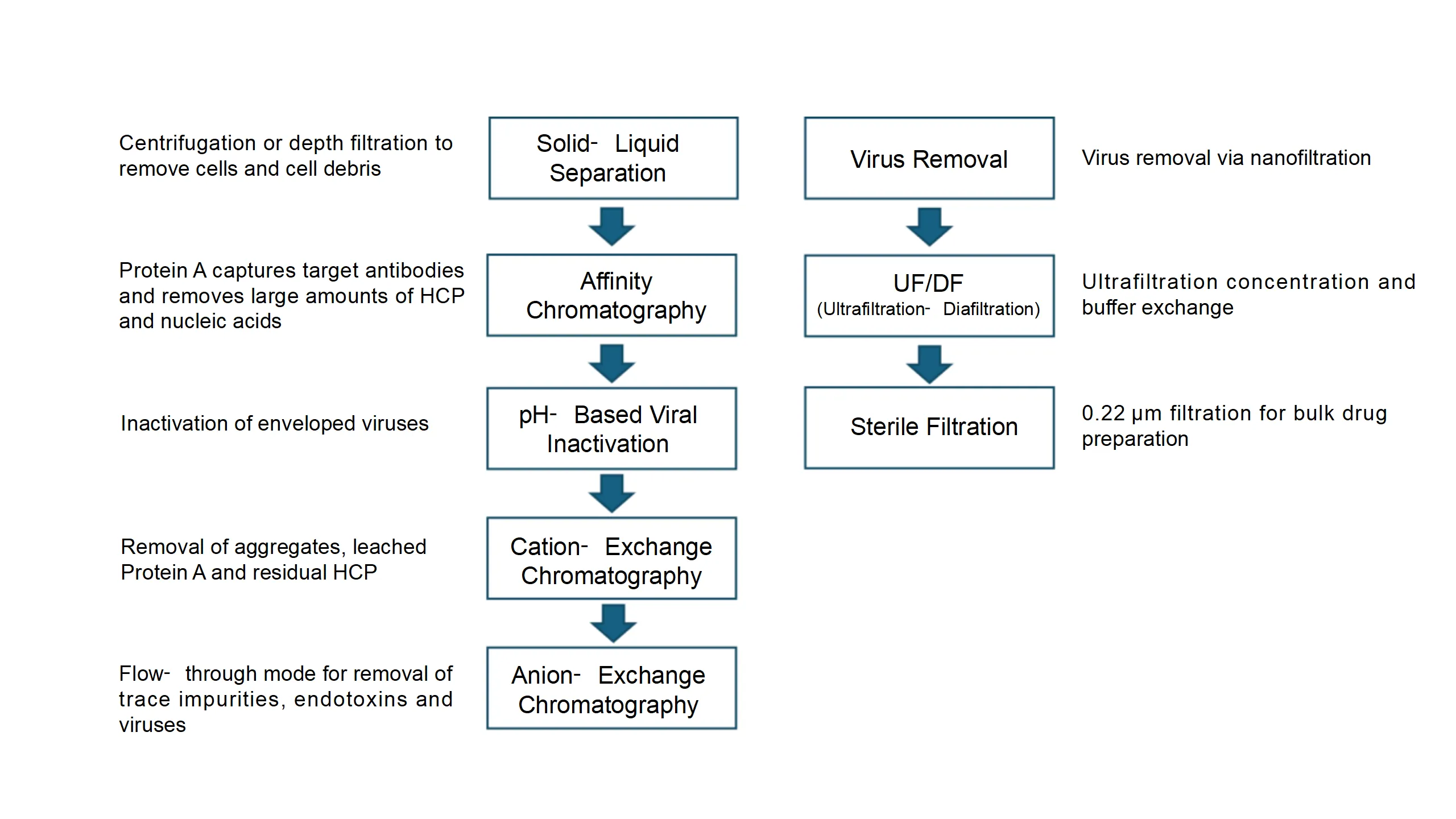
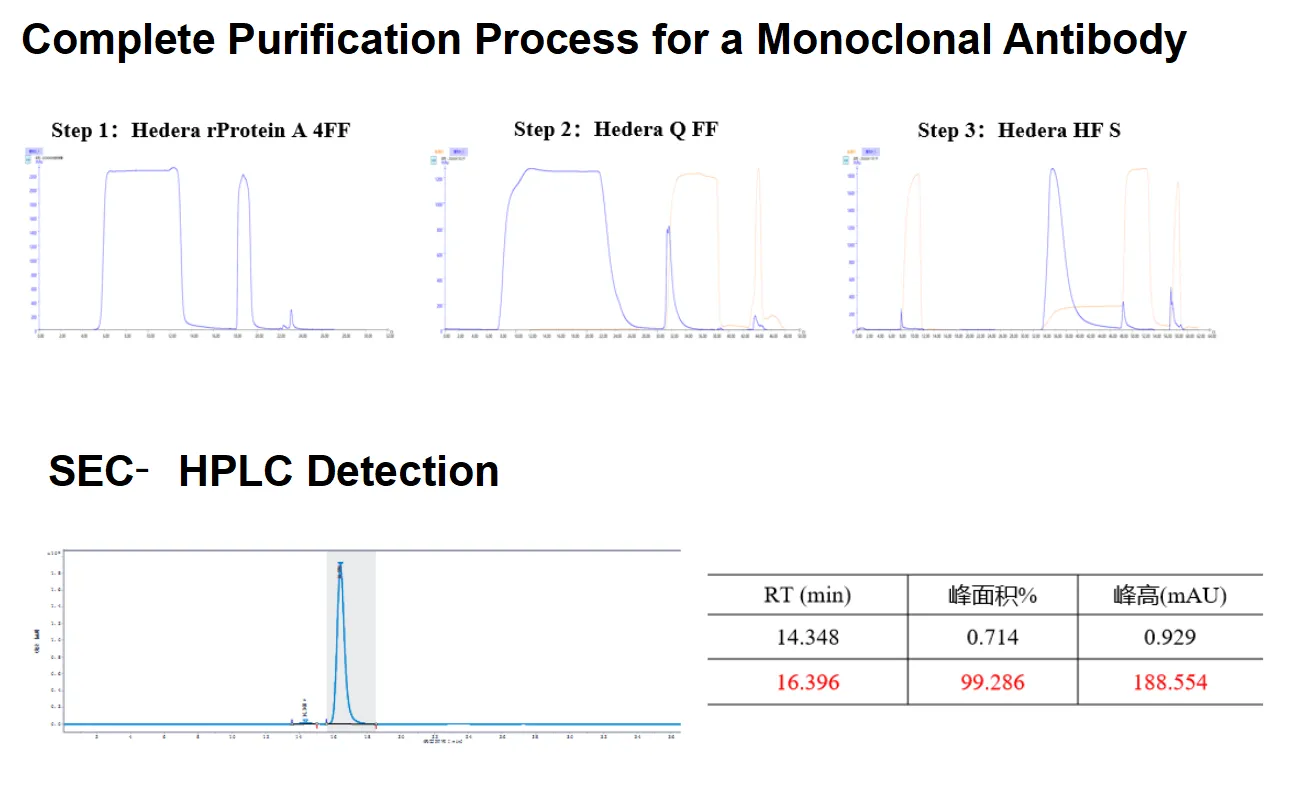
Conclusion: After three‑step purification, the final antibody product achieves purity >99.2% and overall yield >70%.
3. Principles, Process Functions and Media Selection of Core Chromatographic Technologies
3.1 Affinity Chromatography — The Cornerstone of mAb Capture
Protein A affinity chromatography represents the highest‑technical‑barrier unit in mAb purification and also a major source of process costs. Its working principle originates from Protein A derived from Staphylococcus aureus. This ~42 kDa protein contains five domains capable of binding the Fc fragment of IgG, enabling specific capture of target antibodies. A single round of Protein A affinity chromatography can enrich antibodies from complex cell‑culture feedstock, achieving purity above 95%, while removing the vast majority of host‑cell protein (HCP), nucleic acids and medium‑component residuals. The performance of this step directly determines the processing capacity and cost baseline of the entire purification process.
Three key evaluation indicators for Protein A affinity media:
Dynamic binding capacity: Determines single‑batch processing capacity and filler consumption. Higher capacity allows processing of more feedstock with the same column volume, or reduces media consumption for identical throughput, lowering capital investment and per‑batch consumable costs. Hedera‑series affinity media from Hand‑Tech deliver industry‑leading capacity performance.
Alkali resistance: Industrial manufacturing adopts sodium hydroxide for cleaning‑in‑place (CIP) to strip bound impurities and regenerate media. Media tolerant to 0.1‑0.5 M NaOH cleaning extend service life and reduce consumable costs for production.
Batch‑to‑batch stability: Industrial scaling‑up imposes strict requirements on reproducibility across media batches. Hedera rProtein A media exhibit consistent binding capacity across batches, supporting reliable process reproducibility from lab‑scale testing through commercial‑production scale‑up.
To meet differentiated demands of various process scenarios, Hand‑Tech has launched two Protein A affinity fillers:
| Product Name | Positioning & Application Scenarios | 10% DBC Dynamic Binding Capacity | Alkali Resistance (CIP) |
|---|
| Hedera rProtein A 4FF | Cost‑effective basic variant with moderate capacity, for conventional mAb capture workflows | 40 mg hIgG/mL | 0.5 M NaOH |
| Hedera rProtein A HF | For high‑throughput production scenarios requiring high processing efficiency | 50 mg hIgG/mL | 0.5 M NaOH |
3.2 Ion‑Exchange Chromatography — Workhorse for Fine Polishing
Following Protein A affinity capture and pH‑dependent viral inactivation, feedstock still contains antibody aggregates, leached Protein A, trace HCP, endotoxins and other impurities. With outstanding impurity‑removal performance, ion‑exchange chromatography undertakes core intermediate‑ and fine‑polishing tasks.
Cation‑exchange medium Hedera HF S: A strong‑cation‑exchange medium featuring high flow velocity and high binding capacity, mostly applied to remove antibody aggregates in intermediate‑purification workflows.
Anion‑exchange medium Hedera Q FF: A strong‑anion‑exchange medium frequently operated in flow‑through mode. It effectively removes trace impurities including HCP, DNA, endotoxins and viruses for polishing steps.
Process tip: Adjust the sequence of cation‑ and anion‑exchange chromatography flexibly according to antibody isoelectric points and impurity profiles of samples.
3.3 Hydrophobic‑Interaction Chromatography — Aggregate Eliminator
Hydrophobic‑interaction chromatography achieves separation based on interactions between hydrophobic protein surface moieties and hydrophobic ligands on chromatographic fillers. In mAb purification, it is mostly deployed in the polishing stage as a complementary unit to ion‑exchange chromatography. Ligands with varying hydrophobicity such as phenyl or butyl can be selected. During process development, salt concentration and pH must be precisely tuned to strike a balance between purity and recovery and prevent protein precipitation.
Recommended Hand‑Tech media: Hedera Phenyl FF, Hedera Butyl FF
4. Summary and Outlook
Downstream purification for monoclonal antibodies has evolved into a mature system centered on “Protein A affinity capture plus ion‑exchange/multi‑mode polishing”. As the capture step, affinity chromatography enables efficient antibody enrichment from complex feedstock in one pass; filler performance establishes the cost baseline for the whole process. As the polishing workhorse, ion‑exchange chromatography achieves multi‑dimensional impurity removal via combined cation‑ and anion‑exchange workflows. Hydrophobic‑interaction and multi‑mode chromatography offer flexible supplements for specific impurity profiles and process‑simplification requirements.
Hedera‑series chromatographic media from Hand‑Tech fully cover full‑workflow purification demands for mAb downstream processing. The product portfolio includes Protein A affinity, cation/anion‑exchange, hydrophobic‑interaction and multi‑mode media. Customized purification solutions can be tailored according to antibody molecular properties, impurity profiles and production scales, delivering one‑stop chromatographic‑medium support for mAb drug process development, pilot‑scale testing and commercial manufacturing.
For filler trial applications, full‑product‑specification documents or detailed process‑development suggestions, please feel free to contact us.
Company Profile
Jiangsu Hand‑Technology Co., Ltd. (Hand‑Tech), founded in December 2020 with registered capital of RMB 30 million, is a wholly‑owned subsidiary of Jiangsu Hanbon Sci. & Tech. Co., Ltd. It is an innovation‑driven enterprise focused on self‑developed separation‑medium industrialization and application. It has independently developed silica‑based, polystyrene‑based, polyacrylate‑based, agarose‑based, dextran‑based and other media series, covering affinity, size‑exclusion, hydrophobic‑interaction, mixed‑mode, ion‑exchange, pre‑activated, reversed‑phase and normal‑phase products. Its comprehensive product portfolio exhibits excellent batch consistency; product performance meets or exceeds comparable commercial alternatives. The company has obtained ISO 9001 quality‑management‑system certification and maintains a robust quality‑assurance system.
 English
  CN
CN