English
  CN
CN

As the "third wave" in the pharmaceutical industry, small nucleic acid drugs including antisense oligonucleotides (ASOs) and small interfering RNAs (siRNAs) are transforming the treatment landscape for various diseases via potent gene regulation capabilities. Nevertheless, the manufacture of such drugs relies on sophisticated solid-phase synthesis processes, and relevant quality control is critical to product safety and efficacy. In February 2026, the Center for Drug Evaluation (CDE) of the National Medical Products Administration (NMPA) issued the Technical Guidelines for Pharmaceutical Research of Chemically Synthesized Oligonucleotide Innovative Drugs (Trial) (hereinafter referred to as the Guidelines), establishing a clear regulatory roadmap for the R&D, marketing and approval of oligonucleotide pharmaceuticals in China.
In the bulk drug section, the Guidelines specify that relying solely on end-product quality control is technically challenging, mandating sufficient research and process controls starting from the early synthesis stages. For solid-phase synthesis workflows, full documentation is required for critical parameters of each synthetic cycle encompassing deprotection, coupling, oxidation/thiolation and capping, covering starting materials, reagents, solvents, reaction duration, temperature, stoichiometric equivalents and concentration.
Aligned with ICH Q11 principles, the Guidelines mandate in-depth characterization of raw materials such as nucleoside phosphoramidites. Notably, impurities capable of participating in oligonucleotide chain elongation reactions tend to persist in final drug substances and cannot be fully eliminated via downstream purification, necessitating strict source control of such contaminants.
Post-cleavage crude products and oligonucleotide intermediates prior to coupling are defined as critical intermediates in solid-phase synthesis. The Guidelines require formulation of rational in-house specification criteria alongside research on intermediate storage conditions and shelf life supported by validated stability data.
2. How Hanbon Sci.&Tech. Nucleic Acid Synthesizers Comply with Regulatory Guidelines
Jiangsu Hanbon Science & Technology Co., Ltd. is a high-tech enterprise specializing in chromatography technology with long-standing expertise in pharmaceutical equipment manufacturing. Drawing on robust technical know-how in chromatography and synthetic chemistry, the company has developed a full-spectrum regulatory-aligned nucleic acid synthesis system and matching solutions to help innovative pharmaceutical enterprises build compliant and high-efficiency production workflows amid tightened regulatory controls laid out in the Guidelines.
2.1 Regulatory-Compliant Engineering Design
In line with ICH Q9 Quality Risk Management and ICH Q10 Pharmaceutical Quality System governing full-lifecycle drug quality management, Hanbon’s nucleic acid synthesizer software features audit trails, tiered user access management and electronic signature functions that satisfy FDA 21 CFR Part 11 and Chinese GMP data integrity requirements. All wetted component materials and pipeline configurations adopt pharmaceutical-grade specifications to facilitate subsequent formal process validation.
2.2 Precise In-process Regulation Capacity
Targeting stringent regulatory caps on Class III and Class IV impurities and precise execution requirements for chemical backbone modifications and GalNAc conjugation, Hanbon’s synthesis platform leverages high-precision fluidic control to accurately meter reagent dosage, control reaction timing and set wash cycles for each coupling step for maximum coupling efficiency. Precise reaction regulation inherently cuts the formation of failure sequences including n-1 and n+1 variants from incomplete reactions, fulfilling the regulatory intent of impurity abatement via upstream process optimization. Excellent equipment run-to-run reproducibility also ensures consistent diastereomer distribution for phosphorothioate backbones, enabling robust stereochemical quality management for complex modified oligonucleotides.
2.3 End-to-End Process Scalability Support
To avoid drastic post-clinical process changes and ensure manufacturing consistency between clinical and commercial batches as required by the Guidelines, Hanbon delivers an integrated solution spanning laboratory development through full commercial production. All bench-scale, pilot and commercial nucleic acid synthesizer models follow uniform linear scale-up architecture. Synthesized process parameters including deprotection duration, coupling equivalents and sulfurization dosages defined at lab scale can be directly transferred to large-scale production units, mitigating regulatory risks and additional comparability studies stemming from equipment switching.
2.4 Integrated Synthesis-Purification Ecosystem
The Guidelines specify strict control of non-oligonucleotide conjugated moieties (e.g., GalNAc) and highlight the critical role of downstream purification. Hanbon’s comprehensive product portfolio comprises nucleic acid synthesis instruments, chromatography systems, preparative HPLC platforms and tangential flow filtration (TFF) equipment, covering fundamental research, process development and full-scale commercial manufacturing.
The all-in-one "Synthesis + Purification + Ultrafiltration" product lineup enables clients to comprehensively characterize crude oligonucleotide impurity profiles and tailor downstream purification workflows, supporting the holistic quality control strategy stipulated in the official guidance.
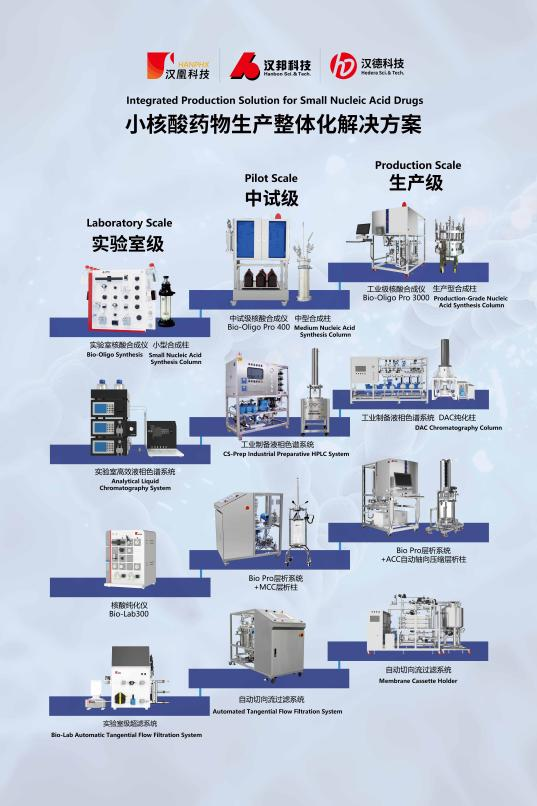
Booming expansion of the small nucleic acid industry has driven increasingly stringent technical specifications for oligonucleotide synthetic yield, product purity and structural stability. As core instrumentation enabling automated, large-scale and high-precision oligonucleotide production, nucleic acid synthesizer performance directly determines bulk drug manufacturing capability and industrial translation of downstream applications.
Independently developed by Hanbon, the proprietary nucleic acid synthesizer integrates proven solid-phase synthesis technology with intelligent centralized control systems, widely applicable to fundamental academic research, in vitro diagnostic reagent development and innovative drug development. Featuring outstanding operational flexibility and long-term running stability, Hanbon’s equipment delivers reliable core hardware to fuel technological breakthroughs in life sciences and industrial upgrading of biopharmaceuticals.
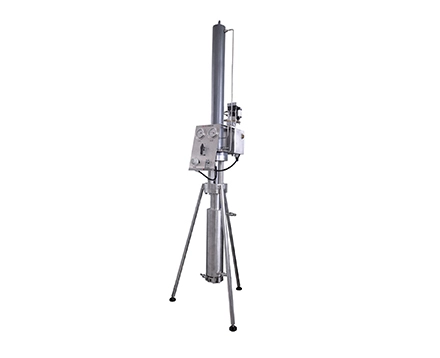
· Laboratory Scale: Bio-Oligo Small Nucleic Acid Synthesis Column, Analytical High Performance Liquid Chromatography System, Bio-Lab Automatic Tangential Flow Filtration System
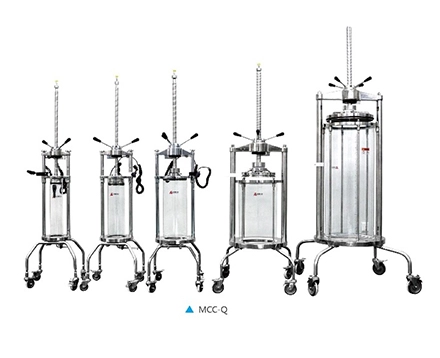
· Pilot Scale: Bio-Oligo Pro 400 Medium Nucleic Acid Synthesis Column, Bio Pro Chromatography System (with ACC axially compressed & MCC chromatography columns), Bio-Lab300 Nucleic Acid Purifier, Automated Tangential Flow Filtration System
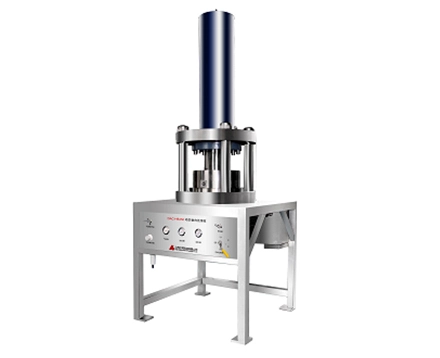
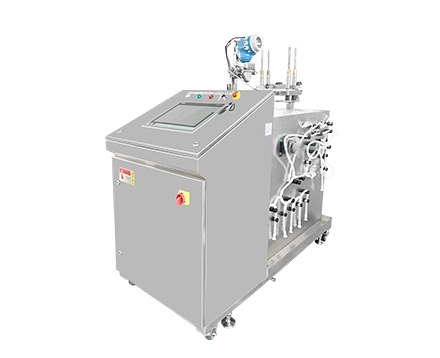
· Production/Industrial Scale: Bio-Oligo Pro 3000 Production-Grade Nucleic Acid Synthesis Column, CS-Prep Industrial Preparative HPLC System & DAC Chromatography Column, Automated Tangential Flow Filtration System with Membrane Cassette Holder
Integrated Production Solution for Small Nucleic Acid Drugs
Release of the Technical Guidelines for Pharmaceutical Research of Chemically Synthesized Oligonucleotide Innovative Drugs (Trial) establishes a standardized regulatory framework guiding domestic small nucleic acid drug development in China. Amid escalating compliance benchmarks, selecting regulation-aligned manufacturing equipment becomes strategically vital for pharmaceutical developers.
Equipped with NMPA and ICH-compliant nucleic acid synthesis platforms, proprietary chromatography purification technologies and seamless scale-up services from lab to commercial production, Jiangsu Hanbon Sci.&Tech. commits to solidifying customers’ manufacturing processes, delivering verifiable analytical data and laying a robust compliance foundation for finished pharmaceutical products. Please feel free to contact our team for consultation regarding your small nucleic acid R&D and manufacturing demands.