English
  CN
CN

The Hedera series Ni affinity chromatography resins from HandTech are built on highly cross-linked agarose matrices, covering three mainstream chelating ligands: IDA, NTA, and TED. They deliver full-spectrum solutions from rapid capture of routine proteins and high-purity fine purification to processing harsh feedstock with additives. The resins have undergone full process validation across E. coli, yeast, mammalian cell and other expression systems. This document systematically breaks down core workflows of His-tagged protein purification, covering purification principles, critical operational tips, resin selection guidelines and practical application cases.
IDA (Iminodiacetic acid): Tridentate ligand
Forms 3 coordination bonds with Ni²⁺, leaving 3 vacant coordination sites for protein binding. It delivers high dynamic binding capacity with abundant protein binding sites. However, the nickel-ligand interaction is relatively weak, making Ni²⁺ prone to leaching in buffers with reducing agents or chelators. Periodic re-charging of nickel ions is required to restore performance, making IDA the cost-effective choice for routine additive-free feedstock.
NTA (Nitrilotriacetic acid): Tetradentate ligand
Forms 4 coordination bonds with Ni²⁺, leaving 2 vacant sites for protein binding. It provides drastically improved nickel ion stability compared to IDA, tolerating low concentrations of chelators and reducing agents while balancing binding capacity and stability to yield higher protein purity. NTA is the most widely adopted ligand for academic research and industrial manufacturing.
TED (Tri-carboxymethyl ethylenediamine): Pentadentate ligand
Forms 5 coordination bonds with Ni²⁺, leaving only 1 vacant site for protein binding. Nickel ions are almost irreversibly immobilized with negligible leaching, allowing direct loading of feedstock containing high concentrations of EDTA and DTT without prior buffer exchange. The tradeoff is lower dynamic binding capacity, making TED exclusively designed for harsh feedstock applications.
| Tag Type | Sequence Characteristics |
|---|---|
| 6×His | 4–10 tandem histidine residues; the standard 6-repeat format is most prevalent |
| 6×HN | Alternating histidine (His) and asparagine (Asn) residues |
| HAT Tag | Complex sequence with multiple histidine residues for enhanced binding specificity |
Common His-Tag Variants
Relative binding strength between common metal ions and His-tags: Cu²⁺ > Ni²⁺ > Zn²⁺ > Co²⁺
After cell lysis, perform high-speed centrifugation (≥12,000 × g, 20–30 min). Collect the supernatant and filter through a 0.45 μm membrane to prevent particulate clogging of resin pores and elevated column backpressure.
For highly viscous samples with high nucleic acid content, add nuclease or extend sonication duration to reduce viscosity and ensure uniform sample loading.
Special handling for lysis buffers containing EDTA/DTT, determined by ligand type:
IDA resins: Buffer exchange via dialysis or desalting columns is mandatory to remove EDTA/DTT before loading.
NTA resins: Tolerate low additive concentrations (≤0.5 mM EDTA, ≤1 mM DTT); buffer exchange is required for concentrations exceeding these limits.
TED resins: Withstand 5–10 mM EDTA/DTT; direct loading without pre-treatment is permitted.
Add 1 mM PMSF or alternative protease inhibitors to lysis buffers to prevent target protein degradation.
Step elution: Simple operation, ideal for large-scale manufacturing.
Gradient elution: Separates contaminants with differential metal-binding affinity to deliver superior protein purity.
Denatured inclusion body lysate of E. coli from an IVD enterprise
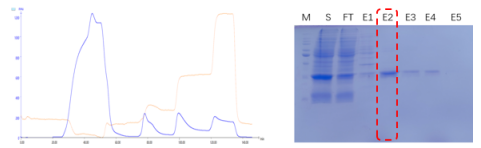
Denatured inclusion body lysate of E. coli from a pharmaceutical manufacturer
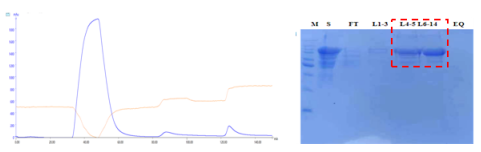
Denatured supernatant of E. coli from a pharmaceutical manufacturer
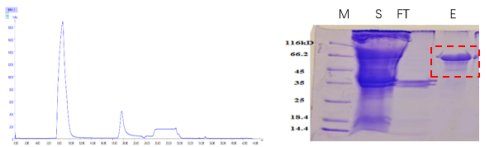
E. coli protein lysate
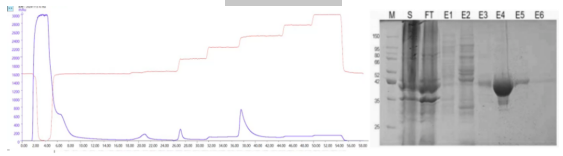
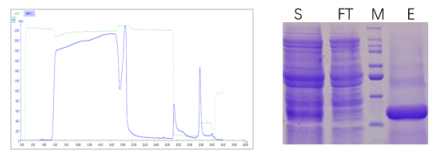
Testing on clarified His-fusion protein feedstock from industrial clients confirmed consistent process performance from lab-scale to full production batches. Batch-to-batch variation in target protein purity and recovery was less than 2%, paired with robust dynamic binding capacity to meet cost-effective large-scale manufacturing demands.
| Application Scenario | Recommended Resin | Typical Dynamic Binding Capacity Reference | Ni²⁺ Stability |
|---|---|---|---|
| Routine His-tagged proteins (prokaryotic/eukaryotic expression) | Hedera Ni IDA FF | 45 mg/mL | Requires periodic Ni²⁺ re-charging |
| High-purity requirements, feedstock with low concentrations of EDTA | Hedera Ni NTA FF | 40 mg/mL | Moderately stable |
| Feedstock containing high concentrations of EDTA/DTT | Hedera Ni TED FF | 20 mg/mL | Near-zero nickel leaching |
Note: Dynamic binding capacity varies with target protein molecular weight, flow rate and buffer conditions; values above serve as typical reference ranges, with actual performance determined by experimental testing.
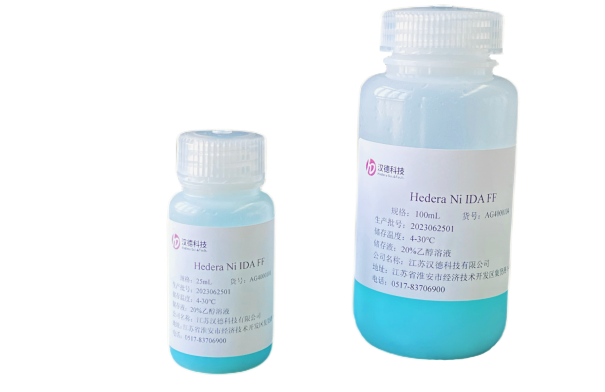
Abundant protein binding sites deliver a typical dynamic binding capacity of ~45 mg/mL; nickel leaching is reversible via Ni²⁺ re-charging for low long-term operational costs.
Robust chemical resistance supports clean-in-place (CIP) regeneration with 0.5 M NaOH to eliminate accumulated contaminants and restore performance.
Broad compatibility with prokaryotic and eukaryotic expression systems, tolerating denaturants including 8 M urea and 6 M guanidine hydrochloride.
Fully validated for process scale-up from lab trials to full production for diverse target biomolecules.
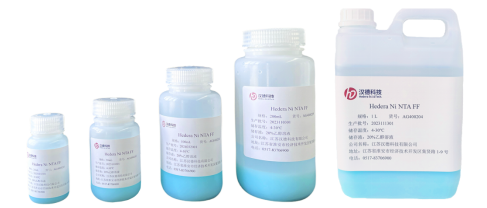
Strong Ni²⁺ immobilization tolerates low levels of DTT and EDTA, minimizing nickel leakage during purification and yielding high-purity target protein.
Under standardized testing, separation performance matches leading commercial competitors, with less target protein loss in flow-through fractions and superior binding capacity.
Fully scalable across academic small-scale purification, pilot trials and full industrial production with consistent batch-to-batch performance.
The separation performance of Hedera Ni NTA FF is comparable to competing products. It delivers high purity of eluted target protein, while leaving less residual protein in the flow-through fraction, and demonstrates superior dynamic binding capacity.
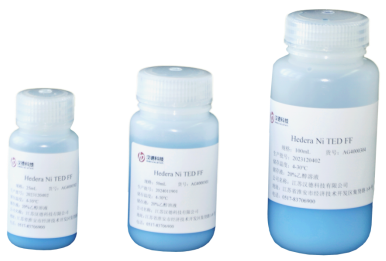
Near-complete suppression of nickel ion leaching eliminates the need for re-charging throughout repeated use for sustained long-term performance.
Direct loading of lysis buffers with high EDTA/DTT concentrations removes the requirement for pre-purification buffer exchange, streamlining workflows and reducing target protein loss.
Optimized for eukaryotic secretory expression systems and feedstock with complex additive mixtures, suitable for academic research and pilot-scale purification.
Cyclic stability testing confirms minimal nickel leaching after repeated load-elute-clean cycles, preserving consistent protein binding performance and extended service life.
Product Order Information
| Resin Grade | Catalog Number |
|---|---|
| Hedera Ni IDA FF | AG40101 |
| Hedera Ni NTA FF | AG40102 |
| Hedera Ni TED FF | AG40103 |
The three differentiated Hedera Ni resin variants from HandTech deliver tailored solutions – from economical high-throughput purification of standard His-tag proteins to robust processing of feedstock loaded with EDTA, DTT and other harsh additives. Fully validated across E. coli, yeast and other expression platforms, the product line provides full downstream purification support from early-stage research to industrial manufacturing.